

14 januari 2026
Separation and dehorning: new footage exposes systematic animal abuse in the dairy industry
Newly recorded photo and video material from Swedish dairy farms shows newborn calves being taken from their mothers and calves attempting to escape as red-hot dehorning irons are pressed against their heads. Documentation released by Djurrättsalliansen (the Animal Rights Alliance) uncovers the suffering caused by routine procedures in a system built on control and exploitation.
Djurrättsalliansen has investigated the Swedish dairy industry and is now publishing material documenting two of the industry’s standard practices. Exclusive video footage shows calves being separated from their mothers immediately after birth. The material also reveals cases where sedation or anaesthesia do not work fully during dehorning, leaving calves conscious as a burning iron is applied to their heads. The photographs and films were recorded in collaboration with the photographer Animals Are Beings Too at Swedish dairy farms during 2025.
– These images do not show isolated incidents. This is how the Swedish dairy industry operates. Humans have created a system where cows are bred for extreme milk production. Their calves are taken away, they are subjected to painful routine procedures, confined in limited spaces, and killed when they are no longer considered profitable, says Malin Gustafsson, spokesperson for Djurrättsalliansen.
Separation and insemination
All milk production in Sweden, including organic production, relies on separating calves from their mothers. Cows in the dairy industry are inseminated to give birth to one calf per year, as cows, like humans and other mammals, produce milk only after giving birth to a child. Within 24 hours of birth, the calf and the cow are separated so that the milk can be sold and consumed by humans.


In the dairy industry, cows’ lives are defined by pregnancy and milk production. Cows are inseminated to give birth to one calf per year in order to maintain high milk yields, and they are milked even during pregnancy. The extreme milk production places heavy strain on their bodies.
After nine months of pregnancy, the calf is born and taken from the cow within 24 hours. The cow’s body is fully adapted to caring for her newborn.
Following the demanding birth, the cow licks her calf. Just five minutes is enough for a cow to recognise her calf later in life.
Under natural conditions, cows care closely for their calves, who would nurse for 7–10 months. In the dairy industry, calves are taken from their mothers within 24 hours—this also applies to organic production.
The newborn calf is moved to a pen that legally may be as small as 1.5 square metres. The calf can be kept there for up to eight weeks—alone, vulnerable, and without any adult to learn from or be protected by.
Eventually, calves are moved into larger pens together with other calves of the same age.
Dehorning
At just a few weeks of age, the majority of calves are subjected to a routine procedure known as dehorning. A heated iron is used to burn away the horn buds so that horns never develop. This is done to prevent injuries in the crowded facilities. The procedure is usually performed under sedation, local anaesthesia, and pain relief, but the area can remain sensitive for several days afterward. In some cases, the sedation or anaesthesia does not work fully, which the documentation by Djurrättsalliansen shows, leaving the calf partially conscious and reacting to pain.
– These methods comply with Swedish animal welfare legislation and are standard practices—normalised steps in a system built on control, profitability, and efficiency. Despite this, many people are unaware that calves are subjected to this treatment, says Malin Gustafsson.
When calves are a few weeks old, most undergo the standardised procedure of dehorning. A heated tool is used to destroy the horn buds, preventing horn growth and reducing the risk of injuries in confined environments.
The procedure is normally carried out using sedatives, local anaesthetic, and painkillers, yet the area may remain sore for several days.
In some cases, sedation or anaesthesia does not take full effect, meaning the calf remains partially conscious and responds to the pain.
Dehorning reduces the risk of animals injuring each other, as well as the risk of injury to humans if animals resist. Dehorning and other methods that limit cows’, bulls’, and calves’ ability to resist are built into the production model, designed to minimise costly disruptions to production.
Milk causes lasting harm
Djurrättsalliansen has examined the Swedish dairy industry. The unique documentation bears witness to the lifelong harm suffered by cows, calves, young bulls and heifers so that humans can drink cow’s milk. See more of the new images and films and read more about the dairy industry.
Investigating the entire dairy industry
Beyond separation and dehorning, Djurrättsalliansen’s newly recorded photos and videos provide insight into the daily lives of cows in the dairy industry—lives spent on hard concrete floors in factory-like environments, governed by automated systems where the primary measure of value is the number of litres of milk produced.
The investigation also highlights the close connection between the dairy and meat industries, revealing the fate of many male calves born to cows exploited for milk production. These calves are often sold to specialised beef producers, where many spend their entire lives indoors before being slaughtered at around 18 months of age.
Consumers of dairy products directly contribute to animals being killed. Around 65 percent of all beef produced in Sweden comes from the dairy industry. This includes calves born to sustain milk production and cows who are no longer considered profitable. On average, cows used in dairy production are killed at around five years of age, often due to fertility problems or diseases such as mastitis.
In dairy industry advertising, cows are often shown grazing happily on sunlit green pastures. In reality, the everyday lives of animals in the dairy industry are far removed from this idyll. Through effective marketing, the industry has maintained the myth that milk is something cows voluntarily “give” to humans.
– Our investigation is important because it makes visible the reality that calves, cows, and young animals are forced into as a result of human dairy consumption. We hope that more people will take a stand for animals when they see this documentation—by questioning the dairy industry and choosing plant-based alternatives instead of cow’s milk. To end the injustices that animals experience in the dairy industry, active engagement from the public is essential, says Malin Gustafsson.
During december, some of the images by Djurrättsalliansen were displayed in the Stockholm underground. Read more here.
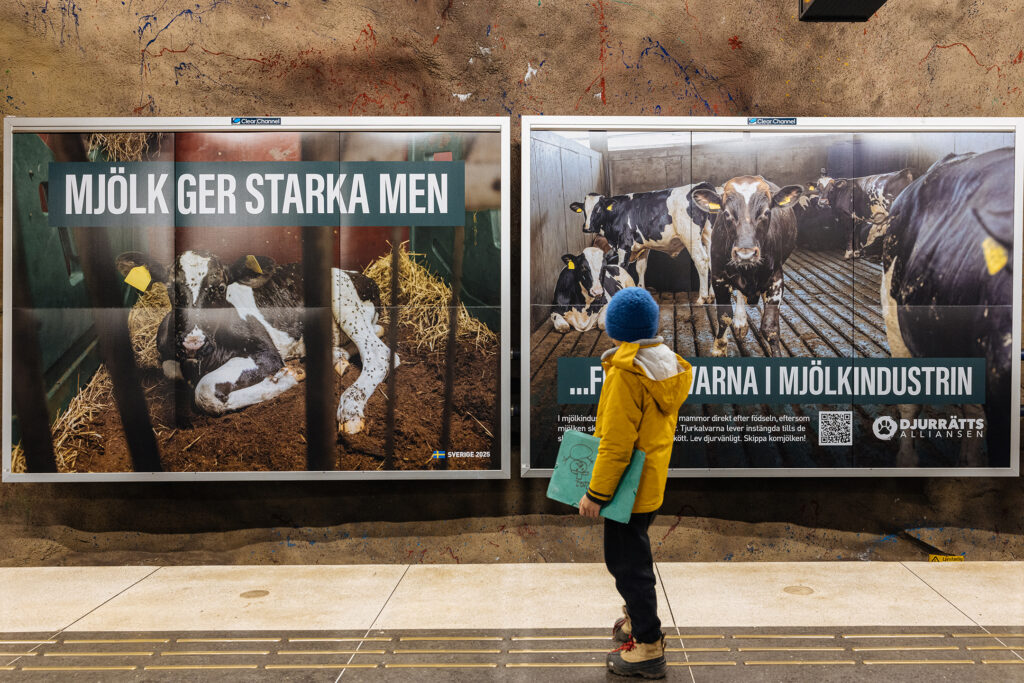
Foto: Djurrättsalliansen/Animals are beings too.
Hidden cameras exposed a dairy farm
In December, the Animal Rights Alliance, together with the investigative TV programme Kalla fakta on TV4, exposed a dairy farm on the island of Öland. Using hidden cameras, the organisation documented cows and calves being abused. The footage reached a wide audience nationwide. Read more about that investigation here.
Cow’s milk? No thanks!
One of the most important things you can do for animals is to choose plant-based food—opting out of animal products such as meat, eggs, and milk. By making these choices in everyday life, you take a stand against animals being subjected to suffering and death in the food industry. Looking for support on your journey toward an animal-friendly lifestyle? Try the Vegan Challenge, where you receive free recipes, shopping lists, and encouragement straight to your inbox.
Support our work
Together, we can be the force for social change that animals so urgently need. Conditions in closed animal factories must be exposed and transformed. It is time to phase out animal industries. Thanks to our donors, we can continue to investigate, document, and expose animal exploitation in Sweden. Every contribution—no matter the size—makes a difference and supports our work for a future where all animals are respected. Thank you.
Nyhetsbrev
Håll dig informerad!
Genom att prenumerera på nyhetsbrevet får du de senaste uppdateringarna om vårt arbete för djuren.

